














The Future of Connected Healthcare: Apps, AI Chatbots, and EHRs Under One Roof
Discover how integrated EHR solutions, AI chatbot development services, and healthcare mobile app development services are transforming digital care delivery. Learn how to build a smarter, connected healthcare ecosystem.
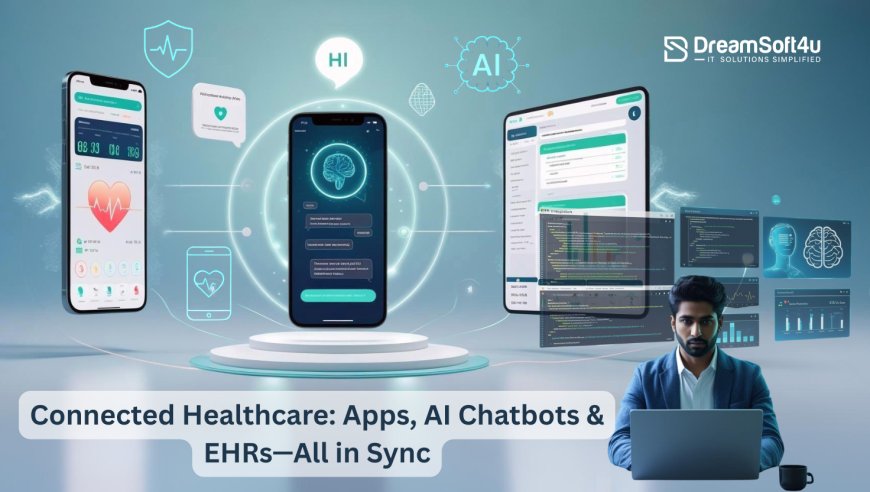
The healthcare industry is undergoing a rapid digital transformation, and the future lies in fully connected ecosystems wherehealthcare mobile app development services, AI chatbot development services, and EHR solutions seamlessly work together.
Disconnected systems lead to inefficiencies, poor patient engagement, and limited insights. Healthcare providers, technology leaders, and clinical teams are now prioritising integrated platforms that deliver smarter, scalable, and more personalised care.
Integrated technologies are not just a competitive advantage-they are becoming a requirement. Patients expect digital access, clinicians need streamlined workflows, and organisations are under pressure to do more with less. A connected ecosystem is the only way to meet these evolving demands while maintaining compliance and operational integrity.
Why Connected Systems Are Now a Necessity in Healthcare
Traditionally, healthcare organisations have relied on siloed tools vendors for appointment apps, another for EMR software, and yet another for AI-powered support. This lack of integration leads to fragmented workflows and poor data accessibility.
A connected healthcare model, powered by custom EHR software, AI chatbot development, and healthcare mobile apps, bridges these gaps by:
-
Enabling real-time data flow across systems
-
Reducing administrative burden
-
Enhancing patient experience and engagement
-
Empowering providers with a complete patient view
-
Minimizing risks associated with manual data entry
According to a 2024 HIMSS report, over 60% of healthcare organizations now prioritize platform integration in their digital strategy. This shift reflects a growing understanding that disconnected tools create operational drag while connected systems unlock exponential value.
The Growing Role of Healthcare Mobile App Development Services
Mobile apps are now essential tools for both patients and providers. With the right partner, a healthcare mobile app development company can build apps that support everything from chronic care management to telemedicine and remote monitoring.
Common use cases include:
-
Virtual care platforms for telehealth visits
-
Patient portals with appointment scheduling, test results, and messaging
-
Care coordination apps for providers to manage multidisciplinary teams
-
Medication and wellness tracking for long-term care
These custom apps also enable features like biometric authentication, real-time health tracking with wearables, and secure in-app messaging-all within a HIPAA-compliant framework.
By partnering with a trusted healthcare app development company, organizations can create scalable solutions tailored to their workflows and regulatory requirements. Such apps enhance patient outcomes, streamline operations, and improve clinician satisfaction by reducing digital friction.
Download: The Ultimate Healthcare App Feature Checklist to plan your mobile health solution.
AI Chatbot Development Services: Automating Engagement at Scale
Todays patients expect instant support. Thats where AI chatbot development services come into play. Intelligent chatbots can automate a wide range of clinical and administrative interactions.
Top applications of AI chatbots in healthcare include:
-
Symptom checking and triage before appointments
-
24/7 appointment scheduling and reminders
-
Insurance claim status inquiries and eligibility checks
-
Automated post-visit follow-ups and satisfaction surveys
-
Mental health and wellness support via conversational interfaces
With advancements in natural language processing and machine learning, chatbots can now interpret complex queries, personalize responses, and escalate cases to human agents when needed. They integrate easily into EHR systems, mobile apps, and CRM platforms, reducing pressure on call centers and front desk staff.
A skilled AI chatbot development company can ensure your solution is compliant, multilingual, and capable of handling high volumes of user interactions without performance degradation.
Want to try it live? Request a free chatbot demo tailored to your organization.
EHR Solutions: The Backbone of Digital Healthcare Systems
A powerful EHR is no longer a digital filing cabinet-it's the central platform for data-driven, patient-first care. The best EHR solutions today are interoperable, cloud-enabled, and built to support integration with mobile apps and AI tools.
Modern EHR software development allows providers to:
-
Customize workflows for their specific practice needs
-
Enable real-time access across departments and locations
-
Automatically sync with healthcare mobile apps and chatbots
-
Generate insightful analytics for outcomes-based care
Organizations that invest in tailored EHR software and EMR solutions report improved provider satisfaction, reduced administrative costs, and faster clinical decision-making.
Whether youre upgrading a legacy system or building a new one, a reliable EHR software development partner ensures smooth data transitions, robust security, and regulatory compliance. Interoperability using HL7, FHIR, and API standards is critical for scalability.
Need help integrating your EHR with new tools? Book a free EHR integration assessment.
What a Connected Healthcare Ecosystem Looks Like
Lets walk through a real-world scenario:
-
A patient opens a custom mobile app and books a telehealth appointment.
-
An AI chatbot triages symptoms and confirms insurance details.
-
The data is pushed to the EHR software, giving the clinician full context before the visit.
-
During the consultation, notes and orders are logged into the EHR in real-time.
-
After the consultation, prescriptions and follow-ups are delivered through the mobile app.
-
The chatbot checks in post-visit to monitor recovery or side effects.
This level of coordination ensures a seamless, personalized journey. Providers benefit from data accuracy, reduced duplication, and stronger patient engagement. Meanwhile, patients enjoy faster care access, clarity, and continuity across their interactions.
Want to see a sample care workflow map? Download our Connected System Blueprint
Common Integration Challenges and How to Overcome Them
Building a unified digital infrastructure takes planning and the right technology partner. Some common challenges include:
-
Compliance
Navigating HIPAA, GDPR, and regional data protection laws requires airtight development practices. Your technology stack must support encrypted communications, access controls, and audit trails.
-
Legacy Systems
Older EHRs and administrative platforms may lack API support. Integration often requires middleware, custom connectors, or a phased replacement strategy.
-
User Adoption
Introducing new tools without proper training can lead to resistance from staff. Focus on intuitive design, change management, and real-time support during rollout.
-
Vendor Coordination
Using multiple vendors for apps, chatbots, and EHRs can slow progress. Opt for an experienced partner who can deliver all three-or coordinate the integration roadmap effectively.
Roadmap for Healthcare Leaders
Heres how to start building a connected digital health ecosystem:
1. Assess Your Current Tech Stack
Evaluate your existing EHR software, apps, and communication tools to identify gaps, inefficiencies, and potential integration points.
2. Identify the Gaps
Are you losing patients due to poor follow-up? Are admin teams manually syncing data between systems? Pinpoint high-friction areas first.
3. Prioritize Based on ROI
Begin with high-impact projects-like automating patient intake using chatbot development services or deploying a secure appointment scheduling app.
4. Choose the Right Partners
Look for a full-service firm offering healthcare mobile app development services, AI chatbot development, and EHR software development under one roof. Ensure they have domain experience and regulatory expertise.
5. Start Small, Scale Fast
Pilot your solutions in one department, gather user feedback, and then scale across your network with informed refinements.
Conclusion
The future of healthcare isn't about using more technology-it's about using the right technology in sync. When your EHR solutions, AI chatbot development services, and healthcare app development services operate cohesively, the results are transformative.
You gain real-time visibility, faster decision-making, improved patient outcomes, and leaner operations. The organizations that thrive in 2025 and beyond will be those who invest in connected digital ecosystems that prioritize both care quality and operational agility.
Ready to transform your systems? Book a Free Strategy Session with DreamSoft4u to explore your connected healthcare solution.