

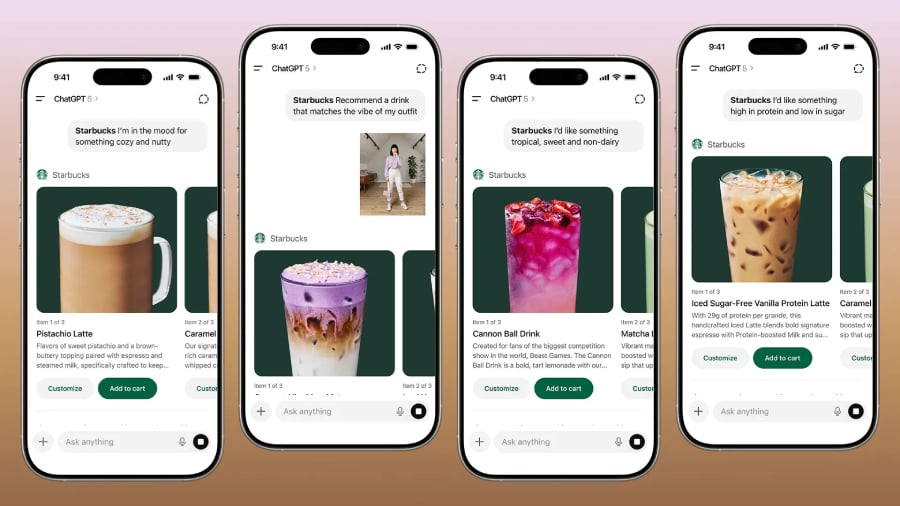
Starbucks is taking customer engagement to a new level by launching a beta app that integrates with ChatGPT, designed to inspire drink selections based on individual moods. This innovative approach, unveiled on a Wednesday, positions Starbucks at the forefront of using artificial intelligence to enhance customer experience.
The new feature allows customers to access the Starbucks mobile app within the ChatGPT environment. Users can communicate their desired drink preferences by using prompts tagged with “@Starbucks.” Additionally, customers have the option to upload photos that represent their drink cravings, and the app will suggest suitable Starbucks beverages accordingly.
Customization is a key aspect of this app; customers can tailor their drink orders before finalizing them in the Starbucks mobile app or on the company’s website, ensuring they can choose their preferred location for pickup.
Rethinking the Ordering Experience
Starbucks aims to innovate the traditional menu-based ordering system. According to Paul Riedel, the senior vice president of digital and loyalty at Starbucks, the company recognizes that customers often approach their drink choices from a feeling rather than a menu. Riedel stated, “Over the past year, one thing has become clear: Customers aren’t always starting with a menu. They’re starting with a feeling…. We wanted to meet customers right in that moment of inspiration and make it easier than ever to find a drink that fits.” This strategy reflects the company's broader effort to reconnect with customers as they navigate their choices.
The launch of this ChatGPT app is part of Starbucks' ongoing efforts to revitalize the customer experience at its cafes. The company has previously introduced various initiatives, such as reestablishing seating arrangements, simplifying its menu, and updating its loyalty program with three new tiers. These steps are part of the “Back to Starbucks” initiative aimed at encouraging more patrons to return to physical locations.
Enhancing Customer and Employee Interaction
This new app is designed to not only enhance the experience for customers but also to support baristas in their roles. Riedel emphasized that the app prepares customers better for their orders, stating, “For our baristas, it means customers arrive feeling more ready, more inspired, and more excited about the drink they’re about to enjoy – which creates even richer moments of connection across the counter.” This sentiment underscores the importance of customer satisfaction and employee engagement within the Starbucks experience.
This launch is not Starbucks’ first foray into AI technologies. Last year, the company collaborated with Microsoft to develop a virtual assistant named Green Dot Assist, which enables baristas to provide quick responses to common questions regarding recipes, service standards, and daily routines through in-store iPads. Such technological advancements indicate Starbucks’ commitment to leveraging AI to improve service efficiency.
Moreover, the Starbucks mobile app has already incorporated features that allow customers to discover new drinks through a trending beverage category influenced by social media, as well as a secret menu accessible under the “offers” tab. This focus on drink discovery is particularly appealing to younger consumers, especially Gen Z, who are drawn to unique and innovative beverage options available at various dining establishments.
Recent reports suggest that Starbucks’ strategies may be yielding positive results, as the company has noted an increase in customer transactions for the first fiscal quarter ending December 28, reversing a trend of declining traffic over the previous two years.
The introduction of the ChatGPT app marks just the beginning of Starbucks’ exploration into AI. Riedel mentioned that the company is committed to finding new ways to utilize technology to “delight our customers while supporting our baristas,” indicating that further innovations are on the horizon.
Related News: In other AI-related developments, Uber has launched an AI cart assistant capable of generating grocery orders from text prompts and handwritten lists, showcasing the growing trend of chat-based shopping tools.
Source: eWEEK News